
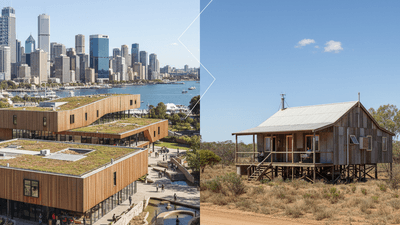



Australian architecture has long outgrown its regional stereotypes. We are no longer defined solely by corrugated iron pavilions or coastal shacks; the Australian design vernacular is now a sophisticated, globally recognized force. This evolution was cemented recently when a diverse cross-section of Australian projects was shortlisted for the prestigious RIBA International Awards for Excellence 2026. Featuring two houses, a hotel, a mixed-use community building, and a primary school, the shortlist highlights a critical reality: Australian design excellence is permeating every typology, from the deeply personal to the highly public.
But while global accolades provide a moment for industry celebration, they represent only the tip of the iceberg. Beneath these polished, award-winning facades lies a profession grappling with massive urban scale, pressing social inequities, unpredictable economic pipelines, and evolving professional identities. For Australian architecture professionals, the challenge is no longer just designing a beautiful building—it is navigating the complex ecosystem that allows such buildings to exist.
The Duality of Scale: From Boutique Excellence to City-Building
The RIBA shortlist underscores Australia's mastery of the bespoke. The inclusion of residential, educational, and boutique commercial projects speaks to a deep understanding of site, climate, and material. However, the everyday reality for many Australian firms involves operating at a vastly different scale.
Consider the recent $1.5 billion 'city-within-a-city' vision unveiled for Sydney's inner west. This proposed mega-development aims to create a vibrant, mixed-use community from the ground up. It highlights a pivot in Australian urbanism: the move away from isolated architectural objects toward integrated, master-planned precincts that blend commercial, residential, and public domains.
Bridging the Gap
For practitioners, the tension between the "RIBA-scale" project and the "city-within-a-city" project dictates the future of firm structuring. Delivering a $1.5 billion precinct requires highly systematized processes, massive joint ventures, and rigorous stakeholder management. Delivering a RIBA-shortlisted primary school requires intense, localized community engagement and bespoke detailing. The most resilient Australian firms are those learning to cross-pollinate the lessons from both extremes.
| Project Typology | Primary Focus | Key Professional Challenges | Market Impact |
|---|---|---|---|
| Bespoke / Award-Driven (e.g., RIBA Shortlist) | Materiality, site-specificity, innovation | Client management, budget constraints, high labor hours per phase | Elevates global brand, attracts top-tier design talent |
| Mega-Scale Urban (e.g., Sydney Inner West) | Density, infrastructure integration, ROI | Navigating zoning, joint-venture coordination, long-term phasing | Shapes city skylines, provides firm financial stability |
| Social / Purpose-Driven (e.g., Nightingale) | Equity, sustainability, community | Alternative funding models, land acquisition, strict margins | Addresses housing crises, builds profound public trust |
Social Conscience as a Design Driver
While the RIBA awards celebrate architectural excellence, the definition of "excellence" in Australia is rapidly expanding to include social impact. Aesthetics are no longer enough; architecture must answer to the housing crisis.
A prime example is the announcement that Nightingale will deliver 70 townhouses on a former rail spur in Melbourne. In a powerful move, Nightingale is partnering with Women's Property Initiatives to ensure that 10 percent of the development is dedicated housing for low-income women and women-led families. This project proves that high-quality, architecturally driven medium-density housing can be financially viable while actively dismantling systemic social disadvantages.
"The Nightingale model forces the profession to look in the mirror and ask: who are we actually designing for? By embedding social equity directly into the pro forma, architects transition from mere consultants to active community builders."
For architecture professionals, the takeaway is clear: alternative development models are gaining immense traction. Understanding the financial and legal structures of deliberative development and non-profit partnerships will soon be as critical as understanding building codes.
Designing for the Next Generation
This evolving social conscience also extends to demographics. The inclusion of an Australian primary school in the RIBA shortlist is particularly telling. It reflects a growing industry mandate to prioritize the end-user experience of our most vulnerable populations. This aligns perfectly with the emerging discourse around seeing cities through young eyes.
Urban environments have historically been designed by adults, for adults—prioritizing vehicular efficiency and commerce over play, safety, and sensory engagement. The push to design cities from the perspective of younger generations requires a radical shift in spatial programming. It means wider, safer pedestrian networks, tactile public realms, and integrating "play" into the urban fabric rather than confining it to fenced-off playgrounds.
The Engine Room: Surviving the Boom and Bust
Of course, none of these projects—whether a RIBA-nominated masterpiece, a $1.5 billion precinct, or a socially driven townhouse development—can be realized without a sustainable business model. The Australian construction and design market is notoriously volatile.
In a recent industry discussion on how to resource unpredictable project pipelines, leaders Lynn Chew, Hazel Porter, and David Welsh shared invaluable insights into managing the boom-and-bust nature of architectural work. Their strategies highlight a critical shift in firm culture:
- Agile Resourcing: Moving away from rigid, siloed studio structures toward fluid teams that can pivot between sectors (e.g., shifting staff from commercial to education when the market turns).
- Cultural Resilience: Building a culture around staff wellbeing. Burnout is the enemy of excellence. Firms that treat staff as expendable resources during a boom will find themselves lacking the talent needed to win work during a bust.
- Transparent Forecasting: Democratizing financial and pipeline information within the firm so that staff understand the "why" behind resourcing decisions, fostering collective ownership.
Redefining the Profession: Who Gets to Claim Excellence?
As the business of architecture evolves, so too does the identity of the architect. The profession is currently engaged in a deep introspection about how it categorizes and values its practitioners. Kali Marnane recently sparked a vital conversation on whether to resist the 'emerging architect' label.
In a profession where licensure takes years and major project timelines span decades, the term "emerging" is often applied to practitioners well into their 30s or 40s. Marnane's insights force us to ask whether this label nurtures young talent by giving them a dedicated platform, or whether it infantilizes highly capable professionals, keeping them out of the room when the $1.5 billion mega-projects are being negotiated.
If Australian architecture is to maintain its global trajectory, it must empower its next generation of leaders now. The designers who will be winning RIBA awards in 2036 are currently the ones navigating the "emerging" label today. Recognizing their full professional agency is crucial to the industry's succession planning.
Looking Forward: A Maturing Architectural Identity
The 2026 RIBA International Awards for Excellence shortlist is a well-deserved milestone for Australian architecture. It proves that our local design language translates fluently onto the global stage. Yet, the true measure of the industry's health lies in how it handles the complexities back home.
From orchestrating massive inner-city transformations and pioneering socially equitable housing models, to rethinking urban spaces for children and safeguarding the mental wellbeing of the workforce, Australian architects are proving their value far beyond the drafting board. The future of the profession belongs to those who can balance the pursuit of global design excellence with the gritty, necessary work of localized social and economic resilience.