
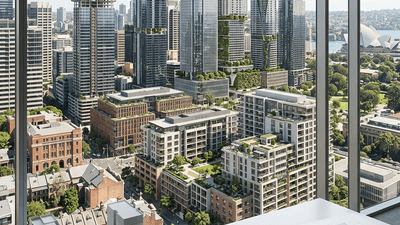



The blueprint for Australia’s next decade of public architecture is being drawn right now, and it is defined by a dual mandate: global ambition and hypersensitive localism. As the nation accelerates toward the Brisbane 2032 Olympics and grapples with the realities of climate change and rapid urbanization, the role of the architect is expanding. We are no longer just designers of singular forms; we are choreographers of urban legacy, sustainability, and civic resilience.
This evolving reality has been starkly highlighted by a flurry of recent industry developments. From the appointment of high-profile design teams for major Queensland sporting arenas to ambitious 10-year urban strategies in Western Australia and critical updates to our national building codes, the message for Australian practitioners is clear: the future belongs to those who can seamlessly integrate spectacle with sustainability.
The Olympic Catalyst: Redefining Regional Arenas
The decentralised nature of the upcoming Brisbane 2032 Olympic and Paralympic Games is proving to be a massive boon for regional infrastructure. Recently, the Queensland Government announced the principal architects for two pivotal projects, setting the tone for the state's sporting architectural vernacular.
As reported by ArchitectureAU, Cox Architecture and Danish firm 3XN have been appointed to design the new Gold Coast Arena, while Architectus will spearhead the Barlow Park Stadium upgrade in Cairns. These appointments are highly strategic and offer valuable insights into current procurement trends for tier-one public projects.
The Power of the Joint Venture
The pairing of Cox Architecture and 3XN for the Gold Coast Arena is a masterclass in modern joint-venture strategy. 3XN brings a globally recognised portfolio of innovative, socially interactive public buildings (having already made a massive mark in Australia with Sydney's Quay Quarter Tower and the new Sydney Fish Market). Cox Architecture, meanwhile, possesses an unparalleled pedigree in Australian sports architecture and a deep understanding of local compliance, climate, and construction methodologies.
Designing for the "Everyday" Legacy
In Cairns, Architectus is tasked with upgrading Barlow Park. The challenge here—and indeed for all Olympic venues—is the "legacy mode." The era of building white elephants for a two-week global event is over. Today's sports architecture must be inherently adaptable.
"The true measure of an Olympic venue's success is not how it performs during the opening ceremony, but how it serves its local community on a rainy Tuesday five years after the games have left town."
For practitioners, this means designing with modularity in mind. Temporary seating expansions, multi-use concourses that can host weekend markets, and integration with local transit networks are now non-negotiable elements of the brief.
Beyond the Stadium: Perth’s 10-Year Urban Greening Vision
While Queensland focuses on sporting precincts, Western Australia is looking at the spaces in between. The City of Perth recently endorsed a transformative new 10-year vision developed in collaboration with renowned urban strategy firm Gehl.
This strategy represents a fundamental pivot from vehicle-centric CBD planning to a pedestrian-first, ecologically driven urban core. Perth's vision focuses heavily on transforming key streets into "green spines" and dedicated transit corridors, effectively cooling the city and fostering street-level activation.
For urban designers and architects, Perth's 10-year plan highlights several critical shifts in civic planning:
- Micro-mobility Integration: Designing ground planes that seamlessly accommodate e-bikes, scooters, and pedestrians over private vehicles.
- Urban Canopy as Infrastructure: Treating tree canopies and green walls not as landscaping afterthoughts, but as critical infrastructure to combat the urban heat island effect.
- Permeable Edges: Encouraging commercial buildings to open their ground floors to these new green spines, blurring the line between private lobbies and public plazas.
The Regulatory Backbone: Modernising the NCC
Grand visions for Olympic arenas and green cities are hollow without the regulatory frameworks to ensure they are built to last. This brings us to the critical, albeit less glamorous, side of our profession: building codes.
The Australian Institute of Architects (AIA) has been highly proactive on this front, recently releasing a submission supporting the national commitment to modernising the NCC 2025 updates. The AIA is advocating fiercely for timely adoption to ensure our built environment is sustainable and future-ready.
As we approach the implementation of NCC 2025, architects must prepare for more stringent requirements. The days of treating compliance as a box-ticking exercise at the end of the design development phase are gone. Energy modelling, condensation management, and carbon accounting must now be integrated from the initial sketch phase.
| Focus Area | Current Approach (Pre-2025) | Future-Ready Approach (NCC 2025 & Beyond) |
|---|---|---|
| Thermal Performance | Minimum star ratings, often achieved via bolt-on solutions. | Holistic passive design, strict thermal bridging mitigation, and whole-of-home energy budgets. |
| Condensation | Basic vapor barrier requirements. | Complex hygrothermal modelling to prevent mold in highly sealed, energy-efficient envelopes. |
| Embodied Carbon | Largely unregulated, voluntary reporting. | Increasing pressure for mandatory lifecycle carbon assessments and low-carbon material specification. |
The AIA's push highlights that modernizing the code isn't just about red tape; it's about equipping the profession to design buildings that can withstand the extreme weather events of the next century while actively reducing their operational footprint.
Benchmarking Excellence: The 2026 ACT Architecture Awards
How do we measure our success in navigating these complex demands of legacy, urbanism, and regulation? Peer review remains one of our most potent tools. The AIA has just announced the jury for the 2026 ACT Architecture Awards, with winners slated to be revealed in June.
The composition of these juries and the criteria they employ are shifting. We are seeing a distinct move away from rewarding pure aesthetic novelty toward celebrating architectural interventions that demonstrate measurable social equity, environmental stewardship, and First Nations engagement. Projects that successfully navigate the rigorous new NCC standards while delivering the kind of civic generosity seen in the Perth Gehl strategy or the adaptability required of the new Queensland arenas are the ones that will define architectural excellence in 2026 and beyond.
Conclusion: A Profession at the Pivot Point
The convergence of the upcoming 2032 Olympics, Perth’s urban greening initiatives, and the critical NCC 2025 updates paints a vivid picture of Australian architecture's trajectory. We are moving from an era of isolated architectural objects to an era of interconnected, high-performance civic systems.
For professionals in the field, the mandate is clear. We must broaden our skill sets, embracing joint ventures to tackle mega-projects, integrating rigorous environmental modelling from day one, and advocating for urban masterplans that prioritize human and ecological health. The projects making headlines today—from the Gold Coast to Cairns to Perth—are more than just new buildings; they are the testing grounds for the resilient, adaptable, and community-centric Australia of tomorrow.