
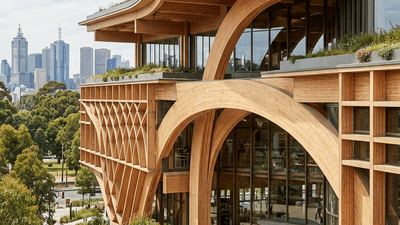



For decades, the architectural vernacular of Australian social housing has been dominated by austere brick, unyielding concrete, and a utilitarian ethos that often prioritized immediate cost over long-term livability. However, the recently completed Glebe social housing project in Sydney signals a profound paradigm shift. By utilizing Cross-Laminated Timber (CLT) to create two distinctly modern yet heritage-sensitive buildings, the project proves that sustainable, high-quality materials are no longer the exclusive domain of luxury residential or premium commercial developments. For Australian architecture professionals, this milestone represents an essential evolution in how we approach civic infrastructure, material lifecycles, and community integration.
The Glebe CLT Project: Heritage Meets High-Tech Timber
Situated in one of Sydney’s most historically dense and architecturally protected suburbs, the Glebe project faced a dual challenge: introducing vital social housing density while respecting the delicate 19th-century terrace typology of the surrounding streets. The solution—two mid-rise buildings constructed primarily from Cross-Laminated Timber—offers a masterclass in contextual sensitivity and low-carbon construction.
The choice of CLT in this context is highly strategic. Beyond the well-documented environmental benefits of sequestering carbon, mass timber addresses several practical urban construction challenges:
- Site Logistics: Glebe's narrow streets make traditional concrete pours highly disruptive. Prefabricated CLT panels allow for quieter, faster, and cleaner assembly.
- Foundation Loads: Timber is significantly lighter than concrete, reducing the required depth and mass of foundations, which is crucial when building adjacent to fragile heritage structures.
- Thermal and Acoustic Performance: Social housing tenants are particularly vulnerable to energy poverty. The natural insulative properties of mass timber, combined with modern sealing techniques, drastically reduce ongoing heating and cooling costs.
"The completion of the Glebe project demonstrates that we do not have to compromise on architectural merit or environmental responsibility when designing for our most vulnerable populations. It sets a new baseline for public housing in Australia."
Comparing Construction Paradigms
To understand the leap forward this project represents, it is useful to compare the traditional social housing model with the new mass timber approach:
| Metric | Traditional Concrete/Brick Build | CLT/Mass Timber Build (Glebe Model) |
|---|---|---|
| Embodied Carbon | High (cement production is highly carbon-intensive) | Negative/Low (timber sequesters carbon if sustainably sourced) |
| Construction Speed | Standard (weather-dependent, requires curing time) | Accelerated (pre-fabricated components, rapid dry assembly) |
| Acoustic/Thermal | Requires extensive secondary insulation layers | Inherent thermal mass and acoustic dampening properties |
| Heritage Impact | Heavy machinery, high vibration risk to neighbours | Lower vibration, reduced heavy vehicle traffic |
The Elephant in the Room: Confronting Material Waste
While the structural achievements of projects like Glebe are worth celebrating, true sustainability in architecture requires us to look beyond the primary structure and into the lifecycle of interior materials. This issue was thrust into the spotlight during Climate Action Week Sydney, highlighted by a stark discarded plasterboard installation.
The installation served as a visceral reminder of the industry's "take-make-dispose" habit. Plasterboard, ubiquitous in both residential and commercial fit-outs, contributes massively to landfill due to the difficulty of separating it from paints, screws, and adhesives. The installation was not merely an art piece; it was an urgent call to action inviting architects and policymakers to consider legislative reform to combat construction waste.
For architecture professionals, this means rethinking the "churn" of interior fit-outs. If we are building 100-year structural shells out of sustainable CLT, we must ensure the interior partitions, linings, and finishes are designed for disassembly and reuse, rather than demolition. Designing out waste at the drafting stage is rapidly transitioning from a fringe environmental pursuit to a core legislative requirement.
Scaling Up: From Local Housing to the 2032 Olympics
The principles of sustainable, community-integrated design seen in Glebe are about to be tested on a monumental scale. As Queensland prepares for the 2032 Games, the architectural community is watching closely. Recently, the siting for the Brisbane Stadium was finalized, and architects were appointed for regional Olympic venues.
Mega-projects historically carry the risk of becoming "white elephants"—structures with immense embodied carbon that offer little post-event utility. However, the current appointments suggest a pivot toward legacy-first design. The regional venues, much like localized social housing, must serve their immediate communities long after the global spotlight fades.
Architects working on these regional venues have an unprecedented opportunity to scale the lessons learned from projects like Glebe. By prioritizing low-carbon materials (including regional Queensland timber), designing for post-games adaptability, and implementing strict material waste protocols, the 2032 Olympics could set a global benchmark for sustainable civic architecture.
Continuing the Conversation: April 2026 and Beyond
The rapid evolution of materials, social responsibility, and mega-project planning requires continuous professional engagement. For those looking to deepen their understanding of these emerging trends, the industry calendar is packed. A comprehensive roundup of what's on in April 2026 reveals a strong focus on sustainable materials, heritage integration, and the future of public housing across various exhibitions and talks nationwide.
Attending these events is no longer just about networking; it is about staying literate in a regulatory and material landscape that is shifting faster than ever before. From understanding the nuances of the National Construction Code's latest energy requirements to mastering the detailing of mass timber, continuous education is the bedrock of future-proof practice.
Actionable Steps for Modern Practices:
- Integrate Mass Timber Early: Do not treat CLT as an alternative to be swapped in later; design for timber from the concept stage to maximize its structural and aesthetic benefits.
- Design for Disassembly: Audit your standard interior details. Can your plasterboard, acoustic panels, and joinery be removed without destruction?
- Prioritize Civic Legacy: Whether designing a micro-housing infill or a regional sports facility, evaluate the project based on its 50-year community utility, not just its immediate brief.
The completion of the Glebe CLT social housing project is not an isolated success story; it is a bellwether. As we look toward the massive civic investments required for the 2032 Olympics and grapple with the urgent need for material waste reform, the Australian architectural profession is finding its new footing. By embracing sustainable innovation, respecting our heritage, and prioritizing social equity, we are quite literally building a better foundation for the future.