
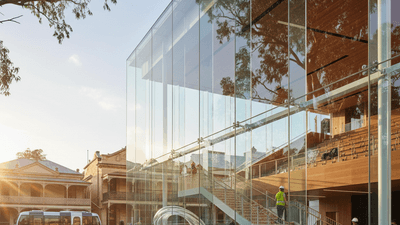



It has been seven years in the making, a period defined by anticipation and the complex engineering required to realize a vision of this magnitude. This week, the Brisbane skyline officially changes with the opening of the Glasshouse Theatre at the Queensland Performing Arts Centre (QPAC). Designed by the local powerhouse Blight Rayner Architecture in partnership with Snøhetta, the project is more than just a new auditorium; it is a statement of intent for a city rapidly marching toward the 2032 Olympics.
However, the opening of this cultural monolith is not the only narrative shaping our built environment this week. From the adaptive reuse of heritage assets in the Blue Mountains to the contentious debates surrounding the "emerging architect" label in Perth, the current discourse in Australian architecture is oscillating between massive civic interventions and intimate, philosophical questions regarding practice and accessibility.
The Glasshouse Effect: A New Cultural Anchor
Selected from 24 international entries, the design by Blight Rayner and Snøhetta is defined by its striking rippled glass façade. This architectural gesture is not merely aesthetic; it serves as a visual metaphor for the nearby Brisbane River and the cultural transparency the institution hopes to embody. By adding this fifth venue, QPAC effectively becomes the largest performing arts venue under a single roof in Australia, a title that carries significant weight in the national arts ecology.
For architecture professionals, the Glasshouse represents a successful model of international-local collaboration. Snøhetta, known globally for the Oslo Opera House, brings a specific sensitivity to ground-plane activation and cultural topography, while Blight Rayner provides the essential local context and delivery expertise required for a project of this scale in the subtropical climate.
"Seven years in the making, the rippled glass design was selected from 24 international entries."
The implications of this opening extend beyond the theatre walls. It sets a high benchmark for the upcoming infrastructure boom in South East Queensland. The challenge now lies in how the precinct activates the space between the buildings—ensuring the "ripple" effect extends into the public realm.
Precincts and Publics: The Shift to Mixed-Use
While Brisbane celebrates high culture, South Australia is reimagining the architecture of sport. The Port Adelaide Football Club has unveiled concept plans for a massive 20,000-square-metre mixed-use precinct. Designed by Cox Architecture, the proposal is a textbook example of the modern sporting hub.
Gone are the days of stadiums sitting as dormant concrete islands during the off-season. The Port Adelaide plan integrates:
- Commercial and retail spaces to ensure daily foot traffic.
- Health and medical facilities, leveraging sports science for the public.
- Residential and community spaces to weave the club into the urban fabric.
For architects working in urban design, this reinforces the trend of "precinctisation"—where single-use typologies are being aggressively retrofitted or designed anew to support 24/7 distinct communities.
The Imperative of Accessibility and Reuse
Moving from the scale of precincts to the intimacy of the human experience, two recent developments highlight the industry's grappling with existing structures and accessibility.
Reviving the Blue Mountains
In a win for inclusive design, a 90-year-old bush retreat in the Blue Mountains has received development approval for a sensitive renovation. The project’s core mission is to create an accessible outdoor camp, enabling children of all abilities to connect with nature.
This project underscores a critical pivot in heritage architecture: the move from preservation-at-all-costs to adaptive inclusion. The design challenge here is significant—retrofitting a rugged, 1930s site to meet modern universal design standards without erasing its historical character. It serves as a reminder that the most sustainable building is the one that already exists, provided it can be opened up to everyone.
The Fate of Melbourne’s Red Stair
Conversely, the City of Melbourne is taking a more pragmatic, perhaps controversial, approach to its urban artifacts. The iconic, 20-year-old Red Stair is slated for renovation. Notably, the council has opted to proceed without a design competition.
The vision involves removing the top level to create a viewing platform. While the structural simplification may reduce maintenance liabilities, the decision to bypass a competition for such a visible South Melbourne site raises questions about how we procure public space renewals. Are we prioritizing efficiency over architectural ingenuity?
Practice and Identity: Defining the Architect
Beyond the bricks and mortar, the profession is currently engaged in a deep introspection regarding identity, craft, and nomenclature.
The "Emerging" Trap
Perth architect Nic Brunsdon has ignited a necessary conversation regarding the 'emerging architect' label. In a recent critique, Brunsdon questions whether this ubiquitous term diminishes the influence and agency of early-career practitioners.
The term "emerging" often implies a state of becoming, rather than a state of being capable. Brunsdon argues that this framing can inadvertently infantilize architects who are already delivering high-quality, high-stakes work. For the industry, this suggests a need to rethink how we award, recognize, and categorize talent. Is it time to retire the label in favor of metrics based on impact rather than longevity?
The Return to Making
Parallel to this is a renewed appreciation for the "maker" architect. In a feature on Ben Grieve-Johnson, we see a return to the tactile roots of the profession. Grieve-Johnson’s insights into his craft and creative process remind us that despite the prevalence of parametric design and AI tools, there is an enduring value in the physical understanding of materials.
Comparative Analysis: Current Australian Interventions
To understand the breadth of work currently reshaping the nation, it is useful to compare these projects by their primary driver and scale.
| Project / Initiative | Scale | Primary Driver | Architectural Challenge |
|---|---|---|---|
| Glasshouse Theatre (QPAC) | Mega-Civic | Cultural expansion & Olympics readiness | Transparency & acoustic isolation in a dense urban site. |
| Port Adelaide Precinct | Urban Masterplan | Community integration & commercial viability | Transforming a sports facility into a 24/7 mixed-use hub. |
| Blue Mountains Retreat | Adaptive Reuse | Universal Accessibility | Retrofitting rugged terrain/heritage for inclusivity. |
| Melbourne Red Stair | Urban Renewal | Maintenance & Safety | Subtraction of structure to improve utility (without competition). |
Conclusion: A Maturing Profession
The opening of the Glasshouse Theatre is a triumphant moment for Queensland architecture, offering a tangible example of how international partnerships can deliver world-class infrastructure. Yet, as we look across the country, the story of Australian architecture is not solely defined by the mega-projects.
It is defined by the tension between preserving the old (Blue Mountains) and streamlining the new (Red Stair). It is defined by the friction between how we label ourselves (Brunsdon) and how we actually make things (Grieve-Johnson). As we move toward the middle of the decade, the most successful architects will be those who can navigate these scales—delivering iconic forms like the Glasshouse while remaining grounded in the human realities of accessibility, community connection, and professional integrity.